















- Home
- Commentaries and Reports
- This is the third in a series of interviews with Edward L. "Ned" Davis
This is the third in a series of interviews with Edward L. "Ned" Davis
- By Delia Stafford-Johnson Columnist EdNews.org
- Published 02/6/2007
- Commentaries and Reports
-
Rating:

Delia Stafford-Johnson Columnist EdNews.org
Ms. Stafford-Johnson is the President & CEO of The Haberman Educational Foundation, Inc. In Houston (TX). For nearly a decade, Ms. Stafford-Johnson directed the nation's largest school district-based alternative teacher certification program in Houston Independent School District. She was twice recognized at White House ceremonies for her success in that program and her advocacy in finding good teachers for children at risk and in poverty. In addition to research interests in alternative teacher certification and teacher selection, Ms. Stafford-Johnson's publications include urban school district-based teacher education, violence prevention, beliefs of effective teachers, student resilience, and research implementation. Ms. Stafford began The Haberman Educational Foundation in 1994 for the purpose of making visible and lasting improvements in the education of America's 15 million diverse children in poverty.
View all articles by Delia Stafford-Johnson Columnist EdNews.orgPresident &CEO
Haberman Educational Foundation
order now
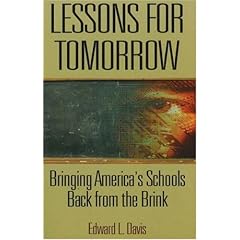
This is the third in a series of interviews with Edward L. "Ned" Davis, author of the acclaimed book on redesigning America's public education system, "Lessons For Tomorrow, Bringing America's Schools Back From The Brink." Davis was a recent recipient of the EdNews Upton Sinclair Awards, 2006 for being one of the ten most outstanding contributors and thought leaders in education. Many 'futurists' paint interesting, even inspiring pictures of where we are going in education. Davis does all of that, but most importantly, his vision is grounded in several major disciplines that are crucial to understanding the evolution of learning.
In the last interview, I spoke to Davis about the future role of learning management systems in empowering students to learn independently and to learn how to learn.
DS—Let'smove from technology, which we talked about in our last interview, to the people side of the future. You have indicated that roles, from teaching to counseling, to being a student will radically change in the next couple of decades. Why is that so?….and give us an indication of some trends that you see.
ND—The world has changed radically, and the institutions of learning, for the most part have not changed with them. Let me throw just a few statistics at you. We have had an upsurge of teachers getting trained and entering the workforce in the last couple of decades, yet the attrition rate has gotten much worse. One third of the new teachers nationwide are gone within the three years, and they don't return. After five years, 46%, or nearly half of new teachers are gone. These are national averages, and it gets worse when we talk about inner city schools.
The environments we thrust teachers into are turning them off. They instinctively know that what they are doing does not work. This is a generally idealistic bunch, who has invested a lot of love and hope into their work, and when the rubber meets the road, large numbers of them become disillusioned.When teachers leave, they say things like, "I just can't do this." I'm not prepared. "My training didn't prepare me for this.""I'm not getting the kind of support I need to get my job done."
Now add to that the fact that the kids in today's classrooms are very different than the ones the present system was designed to teach. Younger teachers know this, and don't feel comfortable in the roles they are cast in—the assembly line roles of homogenous teaching, lots of memorization, preparation for standardized tests, etc.
DS—Well, of course, because of the work I do with the Haberman
Foundation, I am very familiar with these statistics. And, as you know, we focus on the selection process as the way to head off the statistics you have mentioned. We have had dramatic success in improving upon these statistics by showing institutions how to select teachers and administrators that will be effective and not leave.
ND—Of course I am familiar with your work, and believe that it is vitally important. I'm inclined to think that what makes a great teacher is more a set of instincts than it is a trained skill. Nevertheless, we cannot ignore the fact that the design of the present system is woefully obsolete and asks its professionals and its customers (the students) to participate in antiquated rituals that do not develop cognitive capacity or retained learning. And you know, of course, that many seasoned teachers leave the teaching profession later in their careers because they do not get the proper acknowledgement or reward for their effective work with students. In most cases, these are teachers who have learned to work around the system and have to face retribution for their lack of conformance rather than acknowledgment and substantial salary increases.
DS—Tell us, then, what the new roles and new rituals are for people who are going to work together to bring about better and more relevant learning?
ND—Your question gets right to the heart of the matter. First, we need to collectively recognize that schools are very sophisticated human systems that currently lack the functional and support mechanisms to work together collaboratively and realize their goals. In the old factory model, it was mechanization, hierarchy and strict control over outputs that achieved success. We continue to apply these same principles and methods to supposedly produce intelligent, curious and engaged learners today.
In the new regime, we must first recognize that learning has two fundamental dynamics. First, it is nomadic. That is to say, it follows a lone path that is relevant and personal to each individual—it mirrors the combination of challenges, questions, and beliefs that are unique to each young person. We are not molding people, we are nurturing each young person's individuality and quest to realize who they are. But the system we have adheres to achieving homogenous outputs.
Second, learning occurs in a social medium. When you become engaged and interested in a subject, you must become a part of a community of practice in which that subject is put into real world constraints and challenges. In other words, you must put what you have learned to the test of real world situations which always involves a community.
DS—What would this look like in terms of changing roles?
ND—The two principles to operationalize, in terms of what I just said, are individualized learning, and collaborative learning. What that means in terms of changing roles is that we have to organize classrooms around individual learners, recognizing their uniqueness, their talents, their challenges and their personal priorities. Into this mix, we must continue to introduce subject matter, and the pursuit of skills that we have decided as a society are crucial to every individual.
Now, this calls for teachers to learn how to focus on individual needs and develop learning plans that are built around them.
It means that teachers become learning facilitators as opposed to disseminators of information. We have much better ways to disseminate information now. At the simplest level, you can hire the most exciting teacher in the country to put a lecture on a DVD and mix the lecture up with various kinds of visual augmentation to make it even more interesting. You can stop the lecture when you get tired and rerun parts that you tuned out of. This alone is more dynamic approach than lecturing live in front of twenty or thirty kids. You can have a Q&A that follows a lecture on DVD and use hypertext to link to elaboration on any topic or point covered.
All of this means that teachers need to be focusing on individual learning pathways, individual interests and challenges. When they have mastered this skill, they then need to construct collaborative exercises that combine individuals in projects and inquiries that collectively enrich their individual journeys. This calls for the ability to facilitate collaboration among groups, who may even be scattered in space and time—collaboration that will enrich each party to the group. Collaboration is the master skill of the 21st Century. We all need to get better at it to better our relationships, civic lives and career opportunities. There's an interesting book out on the subject now called "Wikinomics."
DS—This sounds like a far greater burden on teachers than what they are doing now. Aren't we going to drive even more of them away?
ND—I don't think so. Remember, in this scenario, the onus to learn is on each individual. Organizing around individuals is certainly more complex, which is why we need to bring a host of other facilitators into the learning process. That is key. Other facilitators include peers, cognitive coaches, community members and career counselors. In "Lessons For Tomorrow", I go into detail about how these groups work together in teams, and use information technology to support collaborative efforts. The big difference in the new scenario is that the student is in the center of it—driving it, learning how to use and manage resources to learn.
DS—By giving more and more responsibilities to learners, is it possible that we overburden them and create an opposite nightmare in which millions fail because they are not capable of handling the responsibilities we have handed them?
ND—Great question! ,and perhaps the most important question every concerned educator should be asking about the future. Of course, what you describe is possible, but it would be the consequence of incompetent design. The prime directive of growing up, learning and becoming an adult is to differentiate oneself. It is a process of taking on increased responsibility. We now react to this very important developmental stage in an almost psychotic way by exerting more control. And we have a chorus of voices out there who make things worse by asking us to control kids more instead of giving them responsibilities.
DS—I'm having trouble seeing how schools get reorganized to give up control. It sounds like more chaos, student misbehavior, etc.
ND—I think we all have trouble with that. We are all products of a system that exerted control, and when we look at it now, it appears that the system is losing control and needs to exert more. I suggest that the solution might be just the opposite. I have already been talking about putting students more in charge of the learning process, with helpers and facilitators to make them better at being in charge. The same applies to governance. We live in a democracy yet we run many schools like they are work camps or juvenile detention facilities.
We need to give adolescents real roles in their own governance—roles that include making rules, voting on changing them and enforcing consequences on their peers who act out. If we want to produce an 18 year old with a sense of community, rule of law and how to participate in a democracy, then we must learn how to effectively include them in those processes as they are growing up and differentiating. The system we have now, for the most part, does not acknowledge the core need that adolescents have to assert themselves, test their own sense of boundaries, discover ethical standards of behavior, and cross the great divide from childhood to adulthood.
DS—This sounds like a great idea!! Are there any models for this kind of student democracy now?
ND—Yes, indeed. There is a whole movement called democratic schooling, founded around such principles. Summerhill School in England, which is still going strong is an excellent example, and the Sudbury Schools, which started in Massachusetts, are another great example. We can learn much from them that could be incorporated into public school design.
DS—OK, so we've talked about new roles for teachers, students, community members and new kinds of professionals and paraprofessionals. What about the role of parents in education?
ND—Very important, needless to say. Talk to any teacher or high school principal and they will happily identify a bunch of meddlesome parents who are always inserting themselves into the affairs of the school—mostly with good intentions for their kids, but often with intrusive styles and annoying results. Many principals will tell you that they expect to be sued "X" amount of times a year by parents who are unhappy with the school's methods and actions. Then, of course, there are many more parents who resist involvement with their children's schools. Right now, the system often invites a dysfunctional result where parental involvement is concerned.
In answer to your question, we lack a proper model, and consequent routines for teachers, parents and students to work together in teams to support individual learners. I believe that parents should be part of the mix, but we need to show them how, and develop appropriate methods and routines for this to happen. Otherwise we invite unwanted tensions between families and schools.
I am working with Dr. Appu Kuttan of the National Education Foundation to put together an action research project to explore new models for student/teacher/parent collaboration as we speak.
DS—I certainly wish you well with your research, and hope we will be among the first to hear about what you learn. I know that teachers are confronted with many hardships in their daily routines, hardships that require a much more sophisticated, systems based, solution. We, at the Haberman Foundation welcome your work. We will talk again. Thank you.
ND—I appreciate the opportunity to share my ideas with the education community as well as with thecitizens of Americawho share an interest in our schools, both public and private.

